
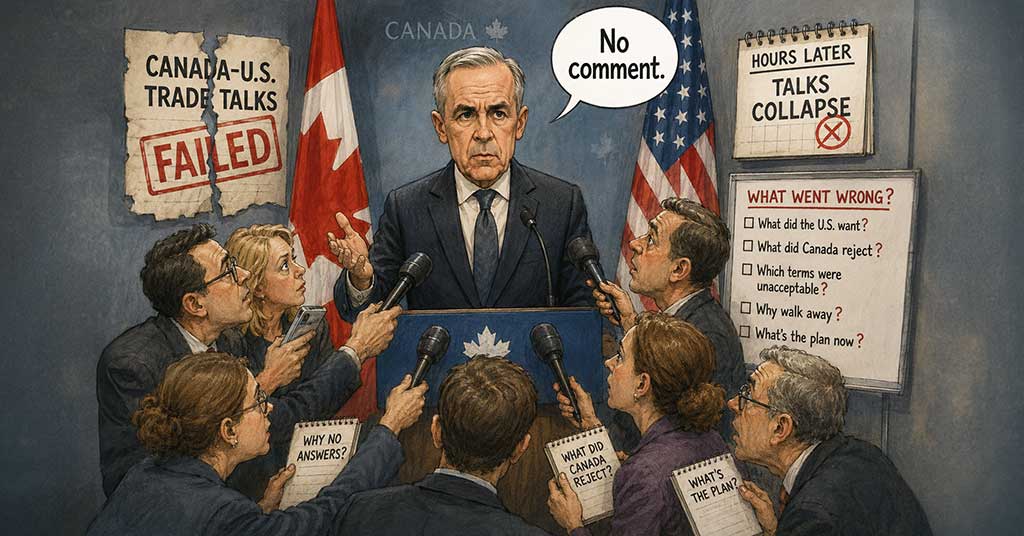
Canadians left in the dark about what went wrong
The state of Canada-U.S. relations has just about flatlined in recent days. We’re in the midst of a tariff war unlike anything we’ve ever witnessed in our long, once-cherished history. Anti-American sentiment has gone through the roof in Canada, and a growing number of Americans are expressing displeasure with our country.
What exactly happened? Good question. Many Canadians had hoped that Prime Minister Mark Carney would shed some light on what led to the breakdown in communication. But while the devil is in the details, Carney barely had any to provide.
Here’s what we do know.
Canada and the U.S. were in the midst of negotiations last week. Both sides were attempting to stave off U.S. President Donald Trump’s threat of 50 per cent tariffs on a wide variety of Canadian goods. The original deadline was Aug. 19, but Trump agreed to a three-day extension to iron out the final details. A breakthrough occurred on Aug. 21 and a deal seemed imminent, but it shockingly collapsed that evening.
“We have recognised from the beginning that America has changed, and that we will not return to our old relationship,” Carney wrote in his statement on Canada-U.S. trade relations. “Our government understood, before many, that America is altering all its trade relationships. Putting tariffs on its closest allies and charging for access to its vast market. We have worked in that context. To strike a fair deal that would provide the best access to the U.S. market and greater certainty to Canadian businesses and workers.”
The prime minister continued, “Throughout, our goal has been to secure the best deal for Canadians, never a deal at any price or on any deadline. In recent weeks, we made important progress toward improving Canada’s position as having the best deal in the world with the U.S. However, that progress has not been enough to meet our objectives for Canadians. As a result, this evening, I have decided to suspend trade negotiations with the U.S. and have directed Canada’s negotiators to return to Ottawa. They have worked hard, in good faith, to defend the interests of Canadians throughout these negotiations up until the very last minute. However, last-minute changes in the U.S. proposed terms were unfair, uneconomic and called into question the reliability of any deal.”
Carney held a news conference the following day. The hope was that it would fill in some of the gaps in knowledge and provide a clearer picture of why Canada left the bargaining table. If you watch or listen to his entire statement, as well as the question-and-answer session with reporters, you’ll find that the political cupboard was extremely bare.
“The devil is in the details, as they say. But as others have correctly pointed out, there are virtually no details related to why this was a ‘bad’ deal for Canada—and why the prime minister directed his negotiators to leave the bargaining table. Small hints and asides, but little else,” I wrote in an X post on Aug. 23 that went viral. “This is a light summation, not a detailed explanation. If you’re content with Carney’s spin, congratulations. I’m not—and many others aren’t either.”
Long story short, Carney wasn’t specific during his news conference. He didn’t focus on numbers, facts, figures, previous amounts or any back-and-forth discussions. Due to the history and importance of the Canada-U.S. relationship, it had to be explained in granular detail. Generalities are acceptable in some cases, but not this one.
We don’t know how many items, issues and concerns were discussed during these negotiations. We don’t know whether there was a back-and-forth process regarding tariffs and tariff-rate quotas related to the auto sector, softwood lumber, steel, aluminum, liquor, and supply management. We don’t know whether the American negotiators presented a single tariff figure as an option to the Canadian side and refused to budge, or were open to ideas and willing to meet in the middle. We don’t know the exact extent that Canadian subsidies for French culture and bilingual labelling on Canadian products became a sticking point (of sorts) during negotiations. We don’t know what U.S. Secretary of Commerce Howard Lutnick and trade adviser Peter Navarro said or did to disrupt the trade deal and claw back concessions in the wee hours of Aug. 21. We don’t even know how involved Trump was in the entire negotiation process.
We’ve also not heard much from the U.S. They could fill in some gaps, too.
What were the main sticking points for the Americans, for example? Were the Canadian negotiators willing to discuss reducing tariff-rate quotas for supply management, a huge sticking point for the president, or lowering any existing tariffs and by what percentage? Were certain items and products kept out of the discussion, and why? Was Canada perceived as being reasonable or unreasonable with respect to proposals and demands?
“The collapse of negotiations and the application of new tariffs on both sides of the border will have serious consequences for our economy,” Conservative MP Shuv Majumdar wrote to Liberal minister Dominic LeBlanc on Aug. 23. “Canadians deserve to know all the facts, to judge and hold accountable all of the decisions that are made which affect their lives. That is why I am requesting that your government release the full details of the proposed deal from which you chose to walk away on Friday evening. If there was a draft text of any agreement that both governments have seen, please release it. The US administration has seen it. Your government has seen it. Canadians deserve to see it.”
He’s right. Liberal cabinet ministers, MPs, party supporters and others seem to believe enough has been said about the dissolution of Canada-U.S. trade relations. In reality, Carney has said almost nothing to date. That’s rather devilish, don’t you think?
Michael Taube is a political commentator, Troy Media syndicated columnist and former speechwriter for Prime Minister Stephen Harper. He holds a master’s degree in comparative politics from the London School of Economics, lending academic rigour to his political insights.
Explore more on Trade, Canada-US relations, Trump administration, Liberal government
The views, opinions, and positions expressed by our columnists and contributors are solely their own and do not necessarily reflect those of our publication.
Troy Media empowers Canadian community news outlets by providing independent, insightful analysis and commentary. Our mission is to support local media in helping Canadians stay informed and engaged by delivering reliable content that strengthens community connections and deepens understanding across the country.

